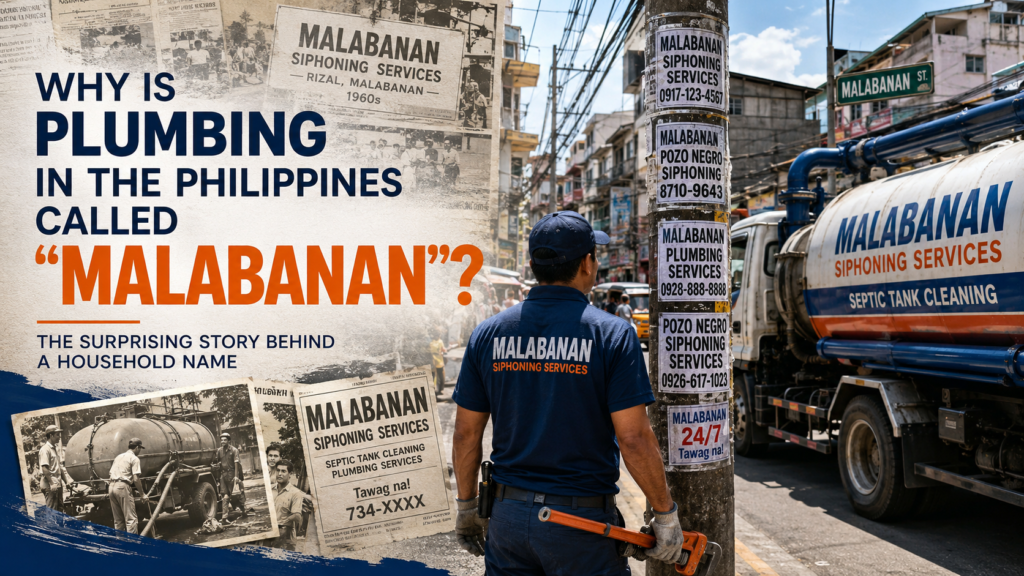
If your toilet backs up, your floor drain starts bubbling, or that unmistakable smell creeps in from the bathroom, chances are the first thing out of your mouth isn’t “I need a plumber.” It’s “Kailangan na natin ng Malabanan.”
But here’s the thing most Filipinos never stop to ask: Malabanan isn’t a type of service. It’s a family name. So how did a surname become the generic word for septic tank cleaning and plumbing across an entire country?
The answer is part business history, part language, and part a marketing phenomenon that brands spend millions trying (and failing) to replicate. Let’s dig in.
It started with one man in Batangas
The Malabanan story traces back to the 1940s, when a man named Melencio Malabanan founded a septic tank and plumbing business in Tanauan, Batangas. At a time when very few people were offering professional waste-removal services, the Malabanan family built a reputation for actually showing up and getting the dirty job done.
That reputation got passed down. Melencio’s daughter, Efipania Malabanan, carried the trade forward and established her own operation in San Pablo City, Laguna. From there, the name spread across generations and provinces, eventually reaching Metro Manila and beyond. What began as a small family venture quietly became the most recognized name in the entire sanitation trade.
Decades of reliable, no-nonsense work did something powerful: it turned a surname into a promise. Say “Malabanan,” and people knew exactly what you meant.
How a surname became a service category
This is where the story gets genuinely interesting from a branding standpoint.
When one brand dominates a category so completely that its name becomes the category, linguists call it a genericized trademark (or a proprietary eponym). The Philippines and the rest of the world are full of these:
- Colgate for any toothpaste
- Xerox for photocopying — “pa-xerox nga”
- Frigidaire (or “ref”) for refrigerators
- Band-Aid for any adhesive bandage
- Google for searching anything online
“Malabanan” joined this exclusive club. Today, when a Filipino homeowner has a clogged septic tank, they don’t search for “septic tank desludging contractor.” They search for “Malabanan near me.” The family name has effectively replaced the entire job description in everyday speech.
That’s the holy grail of brand recognition — and the Malabanan family achieved it by accident, simply by being good at their work for long enough that the public did the marketing for them.
What “Malabanan” actually means today
Strip away the brand origin and “Malabanan services” usually refers to a specific bundle of dirty but essential work:
- Sipsip pozo negro — siphoning out the sludge and waste that accumulates in a septic tank
- Septic tank cleaning and draining — thorough removal of buildup from the vault
- Declogging — clearing blocked toilets, floor drains, kitchen sinks, and pipelines
- Plumbing repair and installation — fixing or replacing pipes, drains, and waterlines
- Septic vault construction — building new tanks to code
The phrase you’ll hear most often is “sipsip pozo negro.” “Pozo negro” literally means “black well” in Spanish, a holdover from the colonial era that originally described a primitive waste pit. Over time, the term shifted to mean the modern septic tank. So when someone says the pozo negro is full, mabaho, or umaapaw, that’s the cue to call for a sipsip — and “Malabanan” is the brand of work being requested.
Why the name stuck so hard
A few cultural and linguistic forces locked “Malabanan” into the Filipino vocabulary:
It’s easy to say and impossible to forget. Three syllables, distinctly Filipino, and tied to a memory most people would rather not dwell on. The discomfort of the situation actually makes the name more memorable.
It filled a vocabulary gap. There was never a clean, common Tagalog word for “septic tank desludging service.” Technical terms felt clinical and “sipsip pozo negro” is a mouthful. “Malabanan” became the shorthand everyone needed.
Word of mouth did the heavy lifting. Septic problems are urgent, stressful, and private. People ask neighbors and relatives for a recommendation, and the name that came back, again and again, was Malabanan. Each emergency reinforced the brand.
The flip side: a name everyone now uses
Here’s the catch to becoming a household word — once a name goes generic, it stops belonging to just one company.
Today you’ll find dozens of businesses across the country operating under some version of the Malabanan name: Malabanan Siphoning, ML Malabanan, JA Torres Malabanan, Mr. Malabanan, Rizal Malabanan, and many more. Some are legitimate, licensed, and properly equipped. Others are fly-by-night operators riding the reputation of a name they have no connection to.
The original Malabanan family business has publicly warned that the name is frequently misused by unauthorized providers who cut corners and skip the proper environmental permits. Legitimate operators today should be DENR-compliant (the Department of Environment and Natural Resources regulates waste disposal), carry proper DTI and business permits, and issue official receipts.
So while “Malabanan” tells you what service you need, it no longer tells you who you’re hiring. That part is on you.
How to actually choose a “Malabanan” service
If you’re calling for septic or plumbing help, treat the brand name as a starting point, not a guarantee. A few quick checks:
- Ask for DENR accreditation. Proper waste disposal is a legal requirement, not an optional extra.
- Confirm they issue official receipts. Legitimate businesses are registered with the BIR.
- Get the pricing upfront. Reputable providers give clear estimates with no hidden charges.
- Check the equipment. Modern vacuum tankers and closed vans signal a serious operation.
- Read reviews and ask for referrals. The same word of mouth that built the name can protect you from the imitators.
The takeaway
So why is plumbing in the Philippines called “Malabanan”? Because one Batangas family was so dependable, for so long, that the country quietly handed their surname over to an entire industry. It’s a rare and remarkable thing — a brand so trusted that the people themselves turned it into a word.
The next time you say “tawag na tayo ng Malabanan,” you’re not just describing a clogged drain. You’re using a piece of living Filipino history, passed down from a man named Melencio who simply decided to do a hard job well.