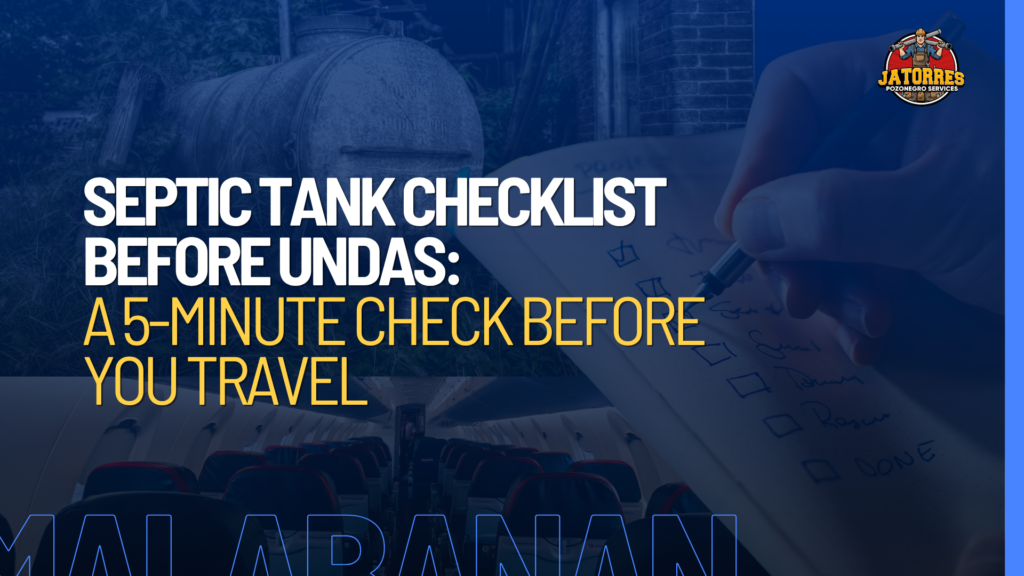
This septic tank checklist takes about five minutes, and it can save you from coming home to a smelly, flooded CR after Undas.
Every year, many families leave Metro Manila and Bulacan for November 1 and 2. Some go to the province to visit their loved ones at the sementeryo. Some stay away for a long weekend. The house is empty, or a kasambahay or relative is left behind to watch it.
The timing matters. Undas falls right at the end of the rainy season. Septic tanks in Caloocan, Valenzuela, Malabon, Navotas and nearby areas have been taking in rainwater and groundwater for months. A tank that was “okay lang” in July may already be close to full by late October.
So before you lock the door, run through this short septic tank checklist. It is simple, it is free, and you do not need any tools. Think of it as the part of your Undas home checklist that most people forget.
Why Do a Septic Tank Checklist Before Undas?
When you are home, you notice small warning signs. The toilet flushes a bit slow. There is a faint smell near the kitchen sink. You fix it or you call someone.
When you are away, nobody notices. A small problem has days to grow.
Here is what can happen while the house is empty:
- A nearly full tank backs up when a house-sitter uses the CR heavily.
- Late-October rain raises the water table and pushes water back into the pipes.
- Water in floor drain traps dries out, and sewer gas comes up into the house.
- A slow drain turns into a fully barado drain.
- A running toilet or leaking faucet adds water to the tank all day, every day.
A septic tank checklist will not fix a full tank. What it does is tell you early, while you still have time to book a pasipsip before you leave. That is the whole point.
If your area flooded this rainy season, read our guide on septic tank overflow after rain first. Heavy rain is one of the most common reasons tanks fill up faster than expected.
The 5-Minute Septic Tank Checklist
Do these five checks in order. Each step of the septic tank checklist takes about a minute. Do them on a normal day, not right after a big household laundry or a party, so you get a fair reading.
1. Flush test: “Mabagal ba mag-flush?”
- Flush each toilet in the house once.
- Watch how fast the bowl empties.
- Listen for gurgling sounds in the bowl or in nearby drains.
- Wait and check that the water level in the bowl settles back to normal.
Good sign: The bowl empties in one strong pull and refills normally.
Warning sign: The water rises high before it goes down, it drains slowly, or you hear gurgling from the shower drain when you flush.
2. Drain test: “Barado ba?”
- Fill the bathroom sink, then pull the stopper.
- Pour one full pail of water into the shower or floor drain.
- Run the kitchen sink for about a minute.
- Watch for slow draining, standing water, or bubbles coming back up.
One slow drain often means a local clog, like hair or grease. Many slow drains at the same time often point to the tank or the main line.
3. Smell check
Walk around the house and the outside area. Sniff near the CR, the kitchen sink, the floor drains, and the ground where the tank is.
A faint smell right after flushing can be normal. A strong, steady “amoy pozo negro” smell, especially indoors, is not.
4. Ground over the tank
Go to where your septic tank is buried, usually under the garage, garden, or side passage. Look and feel for:
- Wet or soggy ground when it has not rained
- Puddles or dark patches
- Cracks in the concrete cover or slab
- A cover that is loose, broken, or sinking
Do not open the manhole. Just look from the surface.
5. Last siphoning date
Ask yourself one question: “Kailan ang huling sipsip pozo negro?”
Check your old receipts, or ask the person who handled it. If you cannot remember at all, that is already an answer. The US EPA notes that household septic tanks are typically pumped every three to five years, depending on household size, how much water you use, and the tank size. Busy homes, small tanks, and houses with many people may need it sooner.
Septic tank checklist results at a glance
Use this table to read your septic tank checklist results:
| Check | Looks okay | Needs attention | What to do |
|---|---|---|---|
| Flush test | Strong flush, normal refill | Slow flush, rising water, gurgling | Book a check before you travel |
| Drain test | All drains clear fast | One slow drain | Possible local clog; try a declog |
| Drain test | All drains clear fast | Many slow drains at once | Likely tank or main line; book siphoning |
| Smell check | No smell or faint smell after flush | Strong, steady sewage smell | Check drain traps; book inspection |
| Ground over tank | Dry, firm, cover intact | Wet, soggy, cracked, or sinking | Book siphoning; keep people off the area |
| Last siphoning | Within your usual schedule | Over 3–5 years, or unknown | Book siphoning before the trip |
If every row says “looks okay,” you can travel with peace of mind. If even one row says “needs attention,” it is better to act now than to worry about it from the province.
One Week Before Undas: Your Timeline
The best time to run your septic tank checklist is one to two weeks before your trip, not the night before. That gives you room to book a service if you need one.
Here is a simple timeline:
- 10–14 days before: Do the full 5-minute check. Find your last siphoning receipt.
- 7 days before: If any check failed, call and book. Late October is a busy time for siphoning crews, so earlier is better.
- 3–5 days before: Clean the kitchen sink strainer and the floor drain covers. Fix any running toilet or dripping faucet.
- 1–2 days before: Do the laundry early so the tank is not hit with heavy water on your last day. Brief your house-sitter.
- Day of travel: Do the “before you lock the door” steps below.
This septic tank checklist timeline also works for Christmas, New Year, and Holy Week trips. Just count back from your travel date.
Before You Lock the Door: Room-by-Room Steps
This part of the septic tank checklist is about leaving the house in a safe, stable state. Go room by room.
Kitchen
- Scrape all food scraps into the trash, not the sink.
- Wipe oily pans with paper towels before washing. Never pour used cooking oil down the drain.
- Clean the sink strainer.
- Run hot water for a minute at the end to push any loose grease down the line.
- If you have a grease trap, check that it is not full. A full grease trap can cause kitchen backups even when the septic tank is fine.
CR and bathroom
- Flush every toilet one last time.
- Check that no toilet keeps running after the flush. A running toilet can add a large amount of water to the tank while you are away.
- Close the toilet lid.
- Make sure no wipes, napkins, or cotton buds are left near the bowl for guests to flush.
Laundry area
- Finish laundry at least a day before you leave.
- Clean the lint filter of the washing machine.
- Turn off the water supply to the washer if it has its own valve.
- Unplug the machine.
Washing machines send a lot of water to the septic system at once. Spreading loads over several days is easier on the tank.
Floor drains
No drain checklist before travel is complete without the floor drains. They have a water “trap” that blocks sewer gas. If the house is empty for many days, that water can dry out. Then the smell comes up.
- Pour a pail of water into every floor drain just before you leave.
- For longer trips, close the drain cover if it has a lid.
- Clear leaves and dirt from outside drains and canals so rainwater does not pool near the tank.
Main water valve
If nobody will stay in the house, think about closing the main water valve. This stops leaks from running for days and keeps extra water out of the tank.
If a house-sitter will stay, leave the valve open, but show them where it is. Tell them to close it if they see a burst pipe or a toilet that will not stop running.
What to Tell Your House-Sitter or Kasambahay
Many homes are not fully empty during Undas. A kasambahay, a tito, or a neighbor may stay to watch the house. Give them a short briefing, and a copy of your septic tank checklist. They should know what is normal, what is not, and who to call.
Tell them these things clearly:
- What not to flush: only human waste and toilet paper. No wipes, napkins, diapers, cotton buds, or tissues in large amounts.
- No oil in the sink: put used oil in a bottle and throw it away.
- Spread out water use: avoid doing all the laundry on one day.
- Warning signs: slow flushing, gurgling, bad smell, water coming up from the floor drain, or wet ground over the tank.
- What to do: stop using the affected CR or drain, and call you right away.
- Who to call: your number, a neighbor’s number, and the hotline of your siphoning and declogging service.
- Safety: never open the septic tank or go near an open manhole. The gases inside can be dangerous.
It helps to write this down. That is what the printable septic tank checklist below is for.
Printable Septic Tank Checklist (Tape It on the Ref)
Copy or print this septic tank checklist and tape it on the refrigerator or near the CR. It works for you before the trip, and for your house-sitter while you are away.
Before the trip (homeowner)
- ☐ Flush test done on all toilets
- ☐ Drain test done on sinks, shower and floor drains
- ☐ Smell check done inside and outside
- ☐ Ground over the tank is dry and the cover is intact
- ☐ Last siphoning date checked: ____________
- ☐ Running toilets and dripping faucets fixed
- ☐ Laundry done at least one day early
- ☐ Sink strainers and drain covers cleaned
- ☐ Floor drains filled with water
- ☐ Main water valve: open / closed (circle one)
While we are away (house-sitter)
- ☐ Flush only human waste and toilet paper
- ☐ No oil or food scraps in the sink
- ☐ Laundry spread over different days
- ☐ Call the owner if a drain is slow or smells bad
- ☐ Never open the septic tank cover
Important numbers
- Owner: ____________
- Neighbor: ____________
- JA Torres Malabanan Siphoning (24/7): 0995-357-0018
Coming Home Checklist
When you get back, run a quick version of the same septic tank checklist. It takes only a few minutes.
- Open windows to let fresh air in.
- Open the main water valve if you closed it. Check for leaks.
- Pour water into all floor drains to refill the traps.
- Flush each toilet and watch the flush.
- Run every sink and the shower for a minute.
- Walk around the house and the tank area and check for smells or wet ground.
- Ask your house-sitter if anything unusual happened.
If everything on the septic tank checklist is normal, you are done. If you notice backups or strong smells, do not wait for it to “go away.” It usually does not.
What If Something Goes Wrong While You Are Away?
Sometimes, even after a good septic tank checklist, things happen. Heavy rain, a guest flushing the wrong thing, or a pipe that finally gives way.
If your house-sitter calls with a problem, here is what to tell them:
- Toilet or floor drain is backing up: a barado CR gets worse with every flush, so stop using that CR. Use another one if the house has it.
- Water is coming up from floor drains: stop all water use, including laundry and showers, until help arrives.
- Strong sewage smell indoors: open windows and doors. Keep children and pets away from the area.
- Ground over the tank is wet or the cover is broken: keep people off that area. Do not step on a cracked cover.
- Never let anyone open the tank or climb into it. Septic gases can make a person faint or worse, and the cover can collapse.
Then call a 24/7 service. A crew can come to the house, check the problem, and do a siphoning or declogging as needed. You may need to arrange how the crew gets in, so agree on this with your house-sitter before you leave. Response times depend on location and traffic; ask the crew for an estimate when you call, around 45 minutes to 2 hours.
Book Before the Late-October Rush
Here is a common pattern: many families remember their septic tank only a few days before Undas. Calls pile up in the last week of October, and schedules fill up.
If your septic tank checklist showed any warning sign, or you simply cannot remember the last siphoning, book early. A septic tank siphoning visit one to two weeks before the trip means:
- You travel knowing the tank has room.
- Your house-sitter can use the CR normally.
- You avoid a stressful emergency call from the province.
Things to have ready when you call:
- Your address and nearest landmark
- Where the tank is located (garage, garden, under the house)
- If the manhole is easy to reach or covered by tiles
- Your last siphoning date, if known
- Your preferred date and time
Pricing depends on tank size, location, and access. Ask for a quote when you call; typical jobs start at around ₱3,000 to ₱5,000. All waste should go to a proper treatment site, such as a DENR-accredited septage treatment facility or local water district treatment plant..
Septic Tank Checklist Tips for Other Long Trips
Undas is not the only time the house sits empty. Use the same septic tank checklist for:
- Christmas and New Year: Many families travel in late December. Holiday cooking also sends more grease to the kitchen drain, so check the grease trap too.
- Holy Week: Long weekends in March or April are common for out-of-town trips. It is also the dry season, so floor drain traps dry out faster.
- Balikbayan visits: When relatives come home and the house is full, the tank works harder. Do the checklist before guests arrive, not just before you leave.
Good septic tank maintenance is mostly about habits. Check it a few times a year, siphon on schedule, and do not flush what does not belong.
FAQ: Septic Tank Checklist Before Undas
How long does the septic tank checklist take?
The core septic tank checklist takes about five minutes for the five main checks. Add another ten to fifteen minutes for the room-by-room steps before you lock the door.
Puno na ba ang pozo negro ko? How can I tell?
Common signs are slow flushing, gurgling drains, several slow drains at once, a strong sewage smell, and wet ground over the tank. If you see more than one of these, the tank may be full. A siphoning crew can confirm it.
Should I get a pasipsip before every Undas?
Not always. Follow your normal siphoning schedule. But if your septic tank checklist shows warning signs, or the last sipsip pozo negro was years ago or unknown, it makes sense to book before the trip.
Is it okay to close the main water valve while we are away?
Yes, if no one will stay in the house. It stops leaks from running for days. If a house-sitter stays, keep it open and show them where the valve is.
Barado ang CR habang wala kami. What should our house-sitter do?
Stop using that CR right away. Do not keep flushing, because the water may overflow. Do not use chemical drain cleaners. Call a declogging service for tanggal bara, and let the owner know.
Can I open the septic tank myself to check if it is full?
No. Septic tanks hold gases that can be dangerous to breathe, and old covers can break. Only trained crews with the right equipment should open a tank. Check from the surface only.
Why does my house smell like sewage after a long trip?
Most often, the water in the floor drain traps dried out, so sewer gas came up. Pour a pail of water into each floor drain. If the smell stays, call for an inspection.
Do you serve on Undas and holidays?
Yes. JA Torres Malabanan Siphoning is open 24/7, including Undas, Christmas, and Holy Week, across North Metro Manila and nearby Bulacan.
Puno na ba o barado bago umalis? Pasipsip na bago mag-Undas. JA Torres Malabanan Siphoning is open 24/7, even on Undas. Call or text 0995-357-0018, our one official hotline. Based in Bankers Village, Brgy. 167, Caloocan, serving North Metro Manila and nearby Bulacan.